Therapeutic Ketosis vs. Standard Keto: What Cancer Patients Need to Know
October 9, 2026
Hyperbaric Oxygen Therapy (HBOT) and Cellular Oxygenation in Cancer Care
October 11, 2026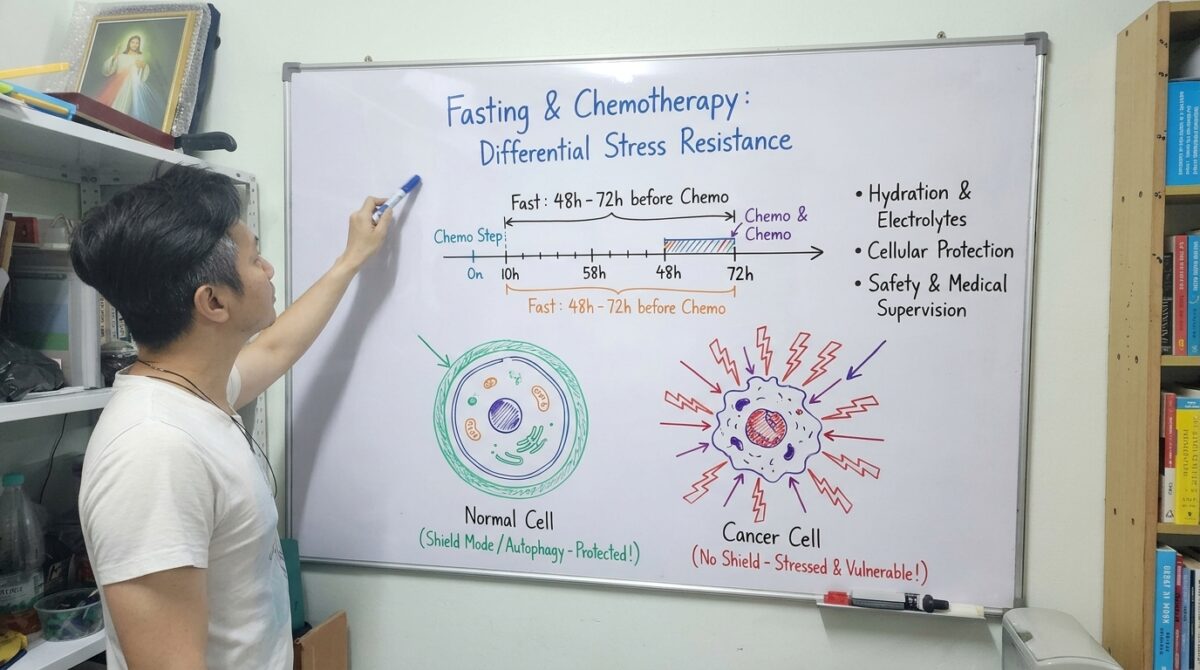
Short-Term Fasting Around Chemotherapy: Mechanisms, Autophagy, and Safety
For decades, the standard nutritional advice given to patients undergoing chemotherapy has been simple: “Eat whatever you can tolerate. Eat ice cream, pastries, milkshakes, just keep your weight up.”
During my own first rounds of chemotherapy in 2022, I followed that advice. I ate sugary foods and heavy snacks whenever my appetite allowed.
Yet despite eating constantly, I suffered relentless nausea, profound fatigue, and severe gastrointestinal side effects.
As Dr. Jean and I continued researching cancer science non-stop even after remission, we dove deep into the clinical research of biogerontologist Dr. Valter Longo at the University of Southern California (USC) Longevity Institute. We discovered a compelling scientific concept: short-term fasting around chemotherapy infusions. It offered a profound physiological confirmation of how metabolic shifts protect healthy cells while leaving malignant cells vulnerable, echoing principles we embraced in my actual protocol.
Clinical trials are now investigating whether strategically timed caloric restriction can protect normal healthy cells from chemotherapy toxicity while simultaneously rendering cancer cells more vulnerable to treatment.
Here is what the published science shows about this phenomenon, how it works in the body, and the strict safety guidelines every patient must know.
What Is Short-Term Fasting Around Chemotherapy?
The Short Answer:
Short-Term Fasting (STF) around chemotherapy is a targeted clinical protocol where a patient consumes only water or a very low-calorie fasting-mimicking diet for 24 to 72 hours prior to chemotherapy and 24 hours following the infusion. Pioneered by Dr. Valter Longo, this strategy relies on a biological mechanism known as Differential Stress Sensitization (DSS), which shields healthy cells from chemotherapy damage while sensitizing cancer cells to drug-induced apoptosis.
To understand why this happens, it helps to look at how normal cells and cancer cells react when food intake drops to zero.
The Biological Mechanism: Differential Stress Sensitization (DSS)
Normal human cells and malignant cancer cells have completely different evolutionary programming:
Differential Stress Sensitization (DSS)
What happens when nutrient intake drops 48 to 72 hours before chemotherapy:
Healthy Normal Cells
- Sense the drop in glucose and IGF-1
- Downregulate mTOR growth and cell division
- Enter protective maintenance & DNA repair
- Activate autophagy to recycle damaged proteins
Malignant Cancer Cells
- Driven by permanently activated oncogenes
- Cannot switch into maintenance or shield mode
- Starve rapidly for fermentable fuel (glucose)
- Suffer catastrophic metabolic oxidative stress
1. How Healthy Cells Respond to Fasting:
Over hundreds of thousands of years of human evolution, our healthy cells learned how to survive famine. When blood sugar, insulin, and IGF-1 levels plummet during a fast, normal cells sense that food is scarce.
They immediately turn off growth and cell division. They batten down the hatches and enter a state of cellular maintenance, repair, and resistance.
Most importantly, they initiate autophagy (literally “self-eating”), a process where cells recycle damaged organelles, clear out debris, and ramp up antioxidant defenses. Because healthy cells stop dividing, chemotherapy drugs (which primarily target rapidly dividing cells) cause significantly less collateral damage to healthy tissues like the bone marrow, gut lining, and hair follicles.
2. How Cancer Cells Respond to Fasting:
Cancer cells, on the other hand, are driven by mutated oncogenes (such as Ras, Myc, and PI3K) that are permanently locked in the “ON” position.
Cancer cells cannot downregulate their growth signals. They cannot enter protective maintenance mode.
When nutrients vanish from the bloodstream, cancer cells continue trying to divide rapidly, only to find an empty fuel tank. They run out of glucose and energy, suffer massive intracellular oxidative stress, and become exceptionally fragile. When the chemotherapy drug enters the bloodstream, the starved cancer cells are overwhelmed and destroyed far more easily.
This is the beauty of Differential Stress Sensitization: the same dietary intervention protects the patient’s healthy body while making the tumor more vulnerable.
What the Clinical Trials Show
In human clinical trials published in leading oncology journals (such as BMC Cancer and Nature Communications), researchers evaluated patients receiving chemotherapy regimens with and without short-term fasting or fasting-mimicking diets (FMD):
- Reduced Treatment Toxicity: Patients who fasted consistently reported significantly less nausea, reduced vomiting, less severe fatigue, and lower rates of diarrhea compared to non-fasting controls.
- Preserved White Blood Cell Counts: Fasting helped preserve leukocyte and thrombocyte (platelet) counts, reducing the severity of neutropenia and lowering the risk of post-chemo infections.
- Enhanced Radiological Response: In several pilot studies (such as the DIRECT trial in breast cancer), patients adhering to fasting-mimicking diets demonstrated higher rates of radiologically confirmed tumor response compared to regular-diet patients.
Stage 4 lung cancer thriver Maggie Jones (@maggie_jones_cancering), producer of the CANCER/EVOLUTION documentary series, has widely shared her clinical journey utilizing prolonged fasting windows around radiotherapy and targeted treatments to support therapeutic efficacy.
Critical Safety Rules: Who Should NOT Fast
Fasting around chemotherapy is a powerful biological intervention. It is not suitable for every patient, and doing it incorrectly can cause severe harm.
Absolute Contraindications (Do Not Fast If You Have):
- Severe Underweight or Cachexia: If your Body Mass Index (BMI) is below 18.5, or if you have lost more than 10 percent of your body weight unintentionally over the last six months, fasting is strictly contraindicated. Protecting muscle mass and caloric reserves is your primary medical goal.
- Type 1 or Insulin-Dependent Diabetes: Fasting while taking insulin or hypoglycemia-inducing medications can cause fatal drops in blood sugar.
- Severe Malnutrition or Eating Disorders: Patients with active nutrient deficiencies, severe electrolyte imbalances, or a history of anorexia must not attempt fasting protocols.
- Kidney Failure or Gout: Fasting increases uric acid breakdown, which can trigger painful gout flare-ups or place acute stress on compromised kidneys.
How to Discuss Fasting With Your Oncologist
If you are interested in exploring short-term fasting or a Fasting-Mimicking Diet (FMD) before your next cycle, speak to your oncology team first. Here is a respectful, science-based way to open the conversation:
“Doctor, I have been reading published clinical studies by Dr. Valter Longo on Differential Stress Sensitization and short-term fasting before infusions to reduce nausea and protect blood counts. If my current BMI and kidney markers look stable, would you support me trying a 24- to 48-hour water fast or fasting-mimicking diet before my next session?”
Bringing published studies to your oncologist frames the topic as evidence-based supportive care rather than an internet fad.
Where to Explore Next
- Previous Article (Day 5): Therapeutic Ketosis vs. Standard Keto: What Cancer Patients Need to Know
- Next Article (Day 7): Hyperbaric Oxygen Therapy (HBOT) and Cellular Oxygenation in Cancer Care
- Read Our Recovery Guide: Uncle BJ’s Journey: From 22 Cycles of Conventional Therapy to Remission
- Explore Our Protocol: My Actual Protocol: How I Went from Stage 4 to Remission