Short-Term Fasting Around Chemotherapy: Mechanisms, Autophagy, and Safety
October 10, 2026
My Actual Protocol: How I Went from Stage 4 to Remission in 2.5 Months
October 12, 2026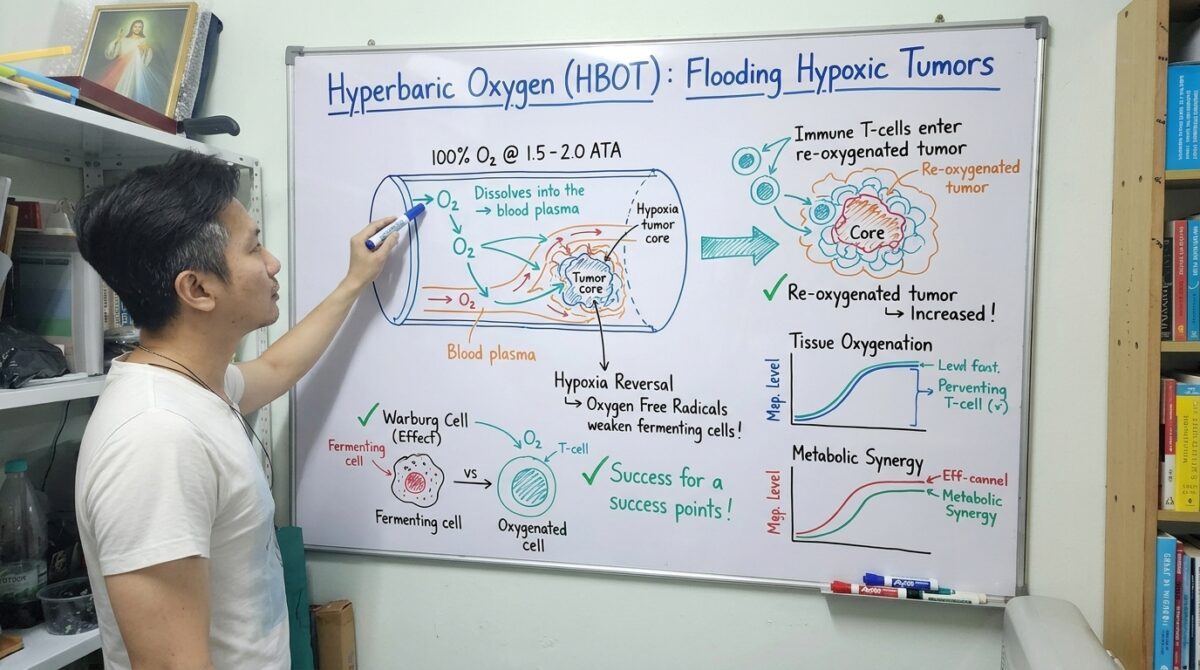
Hyperbaric Oxygen Therapy (HBOT) and Cellular Oxygenation in Cancer Care
One of the most persistent ideas in alternative medicine is that “cancer cannot survive in the presence of oxygen.”
You see this claim quoted in thousands of social media posts, often paired with recommendations for ozone therapy, hydrogen peroxide, or deep breathing exercises.
While the underlying concept traces back to Otto Warburg’s discovery of damaged cellular respiration, the reality inside a living human tumor is far more nuanced. You cannot simply breathe deeply or drink oxygenated water to flood a tumor with oxygen.
However, in specialized clinical oncology and regenerative medicine, physicians utilize a powerful medical technology called Hyperbaric Oxygen Therapy (HBOT).
Prominent integrative physicians like Dr. Leigh Erin Connealy, MD (@connealymd) at the Center for New Medicine and brain cancer thrivers like brain cancer survivor Dr. Pete Sulack incorporate hyperbaric oxygen as a key supportive modality. Furthermore, conventional hospitals worldwide use HBOT as standard-of-care treatment to heal severe radiation damage.
Even after reaching remission in September 2023, Dr. Jean and I have continued researching cancer non-stop. Learning about hyperbaric oxygen and cellular hypoxia was another eye-opening confirmation: it verified why flooding the body with restorative oxygen and supporting cellular vitality alongside my actual protocol helped create the right terrain for lasting health.
Here is what the medical evidence shows about hyperbaric oxygen, how it influences tumor biology, and where its real clinical power lies.
What Is Hyperbaric Oxygen Therapy (HBOT)?
The Short Answer:
Hyperbaric Oxygen Therapy (HBOT) is an approved medical treatment in which a patient breathes 100 percent medical-grade oxygen inside a specialized pressurized chamber (typically at 1.5 to 2.4 atmospheres of absolute pressure, or ATA). This atmospheric pressure dissolves high concentrations of oxygen directly into the blood plasma, cerebrospinal fluid, and extracellular matrix, delivering oxygen deep into poorly vascularized, hypoxic tissues that red blood cells cannot easily reach.
Under normal room conditions at sea level (1.0 ATA), your hemoglobin (the oxygen-carrying protein in red blood cells) is already roughly 98 percent saturated with oxygen. Taking deep breaths does not add much more oxygen to your blood.
Inside a hyperbaric chamber, atmospheric pressure is increased, mimicking diving 30 to 60 feet underwater. According to Henry’s Law of physics, when gas pressure increases over a liquid, more gas dissolves into that liquid.
Under hyperbaric pressure, oxygen physically dissolves directly into your blood plasma. Even if blood vessels are crushed, scarred, or narrowed by tumors or surgical scars, oxygen-rich plasma can seep into starved tissues, dramatically elevating tissue oxygen levels (known as $\text{pO}_2$).
Understanding Tumor Hypoxia: Why Oxygen Scarcity Fuels Cancer
To understand why doctors study hyperbaric oxygen in oncology, you have to understand tumor hypoxia (low oxygen).
As tumors grow rapidly, they create disorganized, chaotic, leaky blood vessels. The centers of solid tumors often become severely deprived of oxygen.
Counterintuitively, hypoxia makes cancer more aggressive:
* Activation of HIF-1α: Low oxygen stabilizes a master genetic switch inside cancer cells called Hypoxia-Inducible Factor 1-alpha (HIF-1α). When HIF-1α is triggered, it signals the tumor to grow new blood vessels (angiogenesis), switch heavily to glucose fermentation, and activate metastatic genes to invade neighboring tissues.
* Chemotherapy Resistance: Many chemotherapy drugs require molecular oxygen to generate reactive oxygen species (ROS) that break DNA strands in cancer cells. In a hypoxic environment, chemotherapy drugs are far less lethal to tumors.
* Radiation Resistance: Radiation oncology relies on oxygen to create free radicals that fix DNA damage in tumor cells (the oxygen enhancement effect). Hypoxic tumor tissue is roughly two to three times more resistant to radiation than well-oxygenated tissue.
By supersaturating tissues with oxygen, clinical HBOT temporarily reverses local hypoxia, shutting down HIF-1α signals and sensitizing stubborn tumor cells to hospital treatments.
The Approved Hospital Uses: Healing Radiation Injury
While HBOT is actively studied as an integrative adjunct, it is already an established, FDA-approved treatment in mainstream hospital centers for specific oncology indications:
- Radiation Necrosis of Bone and Soft Tissue (Osteoradionecrosis): After high-dose radiation therapy (especially for head, neck, and pelvic cancers), surrounding healthy bone and soft tissue can suffer microvascular death and slow necrosis years later. HBOT stimulates new capillary formation (neovascularization), awakens dormant stem cells, and heals painful, chronic non-healing radiation wounds.
- Radiation Cystitis and Radiation Proctitis: Patients who suffer bleeding in the bladder or rectum following radiation for prostate, cervical, or colorectal cancers frequently achieve long-term tissue healing and bleeding cessation through courses of 30 to 40 HBOT sessions.
The Metabolic Synergy: HBOT Paired With Nutritional Ketosis
In cancer research labs, some of the most compelling work on HBOT has been published by Dr. Dominic D’Agostino and Dr. Thomas Seyfried.
Their studies evaluated combining Therapeutic Ketogenic Diets with Hyperbaric Oxygen Therapy:
The Press-Pulse Synergy: Nutrition & Oxygen
Pillar 1: Therapeutic Ketosis
Starves glucose-dependent cancer cells of fermentable sugars and dramatically lowers circulating insulin levels.
Pillar 2: Hyperbaric Oxygen (HBOT)
Floods oxygen directly into plasma and hypoxic tumor tissue, creating targeted oxidative stress in damaged mitochondria.
When cancer cells are metabolically stressed and starved of their primary sugar supply, exposing them to hyperbaric oxygen generates an overwhelming burst of oxidative stress that their impaired antioxidant systems cannot neutralize. Healthy cells, equipped with intact mitochondria and normal catalase and superoxide dismutase enzymes, easily tolerate the oxygen.
Safety, Chambers, and Important Precautions
Not all hyperbaric chambers are the same, and there are critical safety rules to know:
- Hard Chambers (Clinical Grade) vs. Mild Soft Chambers: True medical HBOT uses hard-sided steel or acrylic chambers capable of reaching 1.5 to 2.4 ATA with 100 percent oxygen. Soft zippered chambers (often found in wellness spas) typically reach only 1.3 ATA with ambient air or low-flow oxygen concentrators. While soft chambers can provide relaxation, they do not produce the high plasma oxygen levels required for radiation healing or metabolic oncology synergy.
- Absolute Contraindications: Patients with an untreated pneumothorax (collapsed lung) cannot undergo HBOT.
- Certain Chemotherapy Drugs: Specific chemotherapy drugs (such as Bleomycin, which causes lung toxicity, and Doxorubicin / Adriamycin, which causes cardiac toxicity) have severe adverse interactions with hyperbaric oxygen. HBOT must never be performed concurrently with these medications without explicit clearance from your medical oncologist.
- Ear Pressure & Barotrauma: Like diving, patients must be able to equalize pressure in their ears during chamber pressurization to prevent eardrum trauma.
Week 1 Synthesis: How Metabolic Frameworks Connect to “The 3 Pillars”
Over the past seven days, we have journeyed through the foundational science of cancer metabolism:
1. Day 1: The Warburg Effect and mitochondrial respiration.
2. Day 2: Jane McLelland’s Metro Map and multi-fuel blocking.
3. Day 3: Dr. Nasha Winters’ 10 Terrain Elements (soil vs. seed).
4. Day 4: Repurposed medications like Metformin and Statins.
5. Day 5: Therapeutic ketosis and the Glucose Ketone Index (GKI).
6. Day 6: Short-term fasting and Differential Stress Sensitization around chemo.
7. Day 7: Hyperbaric oxygen and overcoming tumor hypoxia.
Every one of these modalities reflects the core truth of The 3-Pillar Pathway to Remission & Peace:
* You do not need to choose between hospital oncology and supportive care.
* By using Modern Oncology (Pillar 1) to target tumor bulk, Botanicals (Pillar 2) to disrupt pathways, and Metabolic Terrain & Living Faith (Pillar 3) to rebuild your body and spirit, you create an intelligent, whole-person strategy.
In Week 2, we shift our focus from metabolic fuel lines to the astonishing biological power of the plant kingdom: Evidence-Based Foods, Phytochemicals, and Medicinal Mushrooms.
Where to Explore Next
- Previous Article (Day 6): Short-Term Fasting Around Chemotherapy: Mechanisms, Autophagy, and Safety
- Explore Our Protocol: My Actual Protocol: How I Went from Stage 4 to Remission
- Read Dr. Jean’s Perspective: What Science Shows About Nutrition & Recovery
- Discover Our Foundation: How We Help Other Cancer Patients Through Our 3-Pillar Model